
The MakeCU retrospective
Seedlings of MakeCU
MakeCU planning started in June, shortly after I got back from ICRA.
It was me and a squad of ~8 other people meeting over Zoom every week to talk about what work we’ve done, or have to get done, and by when.
Preliminary lessons on leadership
A lesson I learned early on was the art of starting and ending meetings: In research and violin, I’m the one answering to my PI / instructor. But here, people answered to me to lead the meetings. After too many meetings with awkward “okay… see you next week?” I realized the trick was to end with a statement—intonation down.
Through running these meetings, I ran into some more, damning problems:
- Work not assigned never got done.
- As a corollary, people rarely volunteer themselves.
- Zoom meetings can turn impersonal quickly - cameras, mics, and agency off.
- People don’t make decisions for themselves and only wait for me to “assign tasks” to them
I wanted to gravitate away from me lecturing people the entire time, and steer the conversation toward being more productive and collaborative, and friendly. In an ideal world, we would all be friends working together on something we cared about.
HackCon
The hackathon ceiling
As an MLH-affiliated event, I ended up finding my way into their annual hackathon organizer conference in Copake, New York. Though a little corny, it was quite illuminating to see how high the ceiling for hackathons could be. At other schools…
- Teams are getting 150k+ in sponsorships
- They’re sifting through 10k applicants
- One team crafted personality quizzes out of their application forms and hid CTFs in their websites (Hack the North). They also had an “engineering subteam” of 15 people, all dedicated to data analytics, website development, etc.
Hackathons, and the MLH machine
I also grew more invested in the hackathon as a concept—of being the glue between an engineering undergraduate degree and an engineering job in industry.
MLH’s role in the whole operation was fascinating in its own right. They essentially act as an umbrella organization connecting sponsors to hackathons and skimming part of the fat off the top.
- They were an organization of community builders, each invested in organizing hackathons.
- It was a space which was “love-and-kindness”-pilled in a way that I never expected myself to inhabit at the same time.
Locking back in
After that weekend, I came back and shared the spoils of knowledge with everyone else on the MakeCU team.
Functionalizing people through responsibility
I also returned with a renewed mind on delegation: if I reconnect people’s roles to a certain “responsibility,” (eg, being “responsible” for the website displaying accurate information) and asking them to make decisions to get them toward that goal in a more self-guided manner.
Components of the team
Distilling everything I learned about organizing a successful hackathon is way beyond the scope and time constraints of this blog post. But the essential components were as follows
- Money
- Sponsorship
- Finance
- Events
- Workshops
- Food
- Prizes
- Logistics
- Venue
- Safety
- Orders
- Engineering
- Website
- Hardware
- Marketing
- Social Media
- Merch
Memorable moments
For crafting a comprehensive hardware list, I latched onto some friends who I knew were more hardware-literate than I was. James, Isaac, and I met up over a series of lunches to plot out the list of components to order, and how we should effectively distribute it.
Sponsor acquisition was fun—emailing and talking to sponsors taught me how to distill the hackathon deal down into what we want (money to organize the event) vs. what they get (advertising, recruitment, philanthropy), and how to convey that information in a compelling way.
Also noteworthy was the frustrating amount we brushed up against Columbia’s administrative machinery. Every purchase needed a meeting to have it placed. Merch could only be ordered through specific vendors out of “fair labor concerns.” Prizes could only be ordered from the Columbia University Bookstore—to ward off money laundering, nominally.
Sprint to the finish
The week leading up to it was a sprint to the end. T-shirts ended up arriving a couple days before Nov 8th, and I raced to design certificates, nametags, and overseeing that all the merch got printed as they should. Joseph (the goat) handled the hacker communication.
The night before, Joseph, Isaac, Matt, and I stayed from 6:00pm to 2:00am getting every small task ready for the hackathon: Opening / closing ceremony slides, judging forms, day-of emails to hackers, check-in forms, cutting nametags.
The Day Of
A 24hr exam: Non-stop focus
If the week before was a sprint, the Day Of felt like a marathon of intense focus and multitasking. My job was to:
- Greet and entertain sponsors
- Write thank-you cards (which was done hastily, during the morning-of Nov 9th, in the CS lounge)
- Lead the opening and closing ceremonies
- Update the closing ceremony to reflect the winners
- Corral both hackers and organizers to do things
- Make sure food arrived and was served when it was supposed to
- Setup and teardown
- (At some point, I had a 7ft guy from the business school help yell at people to go places 😂)
Joseph was genuinely my other half throughout the event. Hell, it was probably a 80:20 him:me cognitive load split on the day-of. (Facilitated by him just being insane.)
An air of ambition, hope, and Redbull
The final project expo was really heartwarming. The calibre of projects this year was much greater than of last year. The unofficial theme was “trash,” and we saw five different variants of “smart trash can that sorts waste / finds waste disposal.”
The closing ceremony was filled with dozing heads, empty Redbull cans, and latent anticipation. The fact that MakeCU could convince participants to pull an all-nighter to finish their project filled me with a strange but proud feeling.
We announced the winners: a team named Ding Dong, who had built a smart doorbell which would unlock the door from the outside if your face was a verified user on the guest registry.
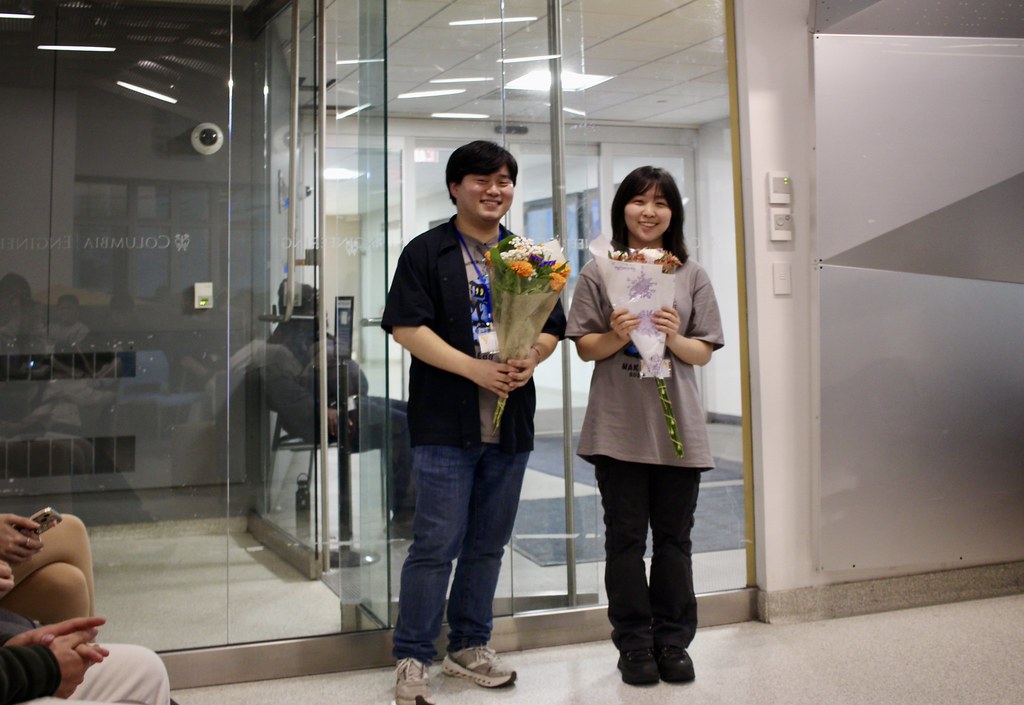
At the end, Celeste brought in flowers for me and Joseph.
Afterword
The victory dinner
It was only after the closing ceremony, after saying goodbye to the final sponsor, that I felt like I could finally relax. The team stayed back to clean-up the hardware, and after people slowly dropped out, the remaining four stragglers all went for dinner at Sala Thai.
Afterwards, I went home and slept.
Pride and sweat-laden takeaways
I was non-verbal for half of the next day out of shell-shock. Honestly, I still haven’t mentally recovered. But, I’ve started feeling genuinely proud of myself.
Organizing MakeCU will forever stay with me for the lessons it taught me on leadership, organizations, and the ways in which working with other people can break down. The combined effort of us 10 led to an event which touched 100+ attendees and left a rippling impact on the Columbia community. It was challenging, grueling, but irrevocably rewarding.
Links
The final list of projects can be found here.
Columbia Engineering also wrote an article on us, called “The 24-Hour Sprint from Prototype to Pitch”.