<?xml version="1.0" encoding="utf-8"?><feed xmlns="http://www.w3.org/2005/Atom" ><generator uri="https://jekyllrb.com/" version="3.9.4">Jekyll</generator><link href="https://hyuncat.com/feed.xml" rel="self" type="application/atom+xml" /><link href="https://hyuncat.com/" rel="alternate" type="text/html" /><updated>2026-04-23T16:35:52+00:00</updated><id>https://hyuncat.com/feed.xml</id><title type="html">Sarah Hong</title><subtitle>Sarah Hong&apos;s personal website and blog</subtitle><author><name>Sarah Hong</name><email>ssh2198@columbia.edu</email></author><entry><title type="html">Eurydice and the porridge pot</title><link href="https://hyuncat.com/blog/eurydice/" rel="alternate" type="text/html" title="Eurydice and the porridge pot" /><published>2025-12-28T00:00:00+00:00</published><updated>2025-12-28T00:00:00+00:00</updated><id>https://hyuncat.com/blog/eurydice</id><content type="html" xml:base="https://hyuncat.com/blog/eurydice/"><![CDATA[<h2 id="eurydice-and-the-porridge-pot">Eurydice and the porridge pot</h2>

<p>I pinch my nose and start<br />
my wading through the amber murk<br />
the porridge pot hides honeyed traps<br />
blueberry buoys, oats and cream<br />
a barely dormant geyser luring prey</p>

<p>a half-dipped spoon<br />
it tethers me to flurried steam above<br />
though slippery on its silver edge<br />
I wrap my limbs around its flowered etchings<br />
clinging, sliding, slowly scaling</p>

<p>sweet allure, a hidden folly<br />
well-meaned fingers, cleanly licked<br />
casting giant shadows on my view</p>

<p>they lift the spoon<br />
and I come too</p>]]></content><author><name>Sarah Hong</name><email>ssh2198@columbia.edu</email></author><category term="poem" /><summary type="html"><![CDATA[Eurydice and the porridge pot]]></summary></entry><entry><title type="html">ParableGPT, Spinozism, and meaning</title><link href="https://hyuncat.com/blog/parablegpt/" rel="alternate" type="text/html" title="ParableGPT, Spinozism, and meaning" /><published>2025-12-24T00:00:00+00:00</published><updated>2025-12-24T00:00:00+00:00</updated><id>https://hyuncat.com/blog/parablegpt</id><content type="html" xml:base="https://hyuncat.com/blog/parablegpt/"><![CDATA[<p>The repository for ParableGPT can be found <a href="https://github.com/hyuncat/parable-gpt">here</a>.</p>

<h2 id="my-origins">My origins</h2>
<h3 id="set-on-a-catholic-course-of-meaning">Set on a Catholic course of meaning</h3>
<p>I grew up Roman Catholic. My grandparents on my dad’s side were devout; praying for me and my dad every day. They raised me when I was an infant, and their piety rubbed off on both me and my parents.</p>

<ul>
  <li>I attended mass every Sunday</li>
  <li>I had godparents</li>
  <li>I checked off all the sacraments I could (Baptism, Eucharist, Confirmation, Reconciliation)</li>
  <li>I went to Sunday school</li>
</ul>

<p>Moreover, I was zealous. I would pray at least ten times a day: right when I wake up, in the car, during silent reading, before meals, on the couch, in the shower, before bed. I paged through the old testament as nightly reading. I even dreamed that I received a parchment from God telling me that I was destined to become an evangelist in His name.</p>

<p>But I grew disenchanted with the church; getting unsatisfying answers to the following questions:</p>

<ul>
  <li>Why can’t women become pastors?</li>
  <li>Why are my friends going to Hell?</li>
</ul>

<p>Gradually, I gradually stopped praying and attending mass. And during the height of the COVID pandemic, the too-pronounced overlap between religious Christians and anti-mask + anti-vaccine Americans disgusted me too much—I proclaimed myself agnostic.</p>

<h2 id="revisiting-religion">Revisiting religion</h2>
<h3 id="a-class-on-origins-and-meaning">A class on origins and meaning</h3>
<p>Since the pandemic, I hadn’t seriously revisited my relationship with religion.</p>

<p>This semester, I took a course called <em>Origins and Meaning</em>, taught by the celebrity physicist Brian Greene. The course centered around unraveling the origins of the universe and humanity’s strategies of constructing meaning in an otherwise meaningless world, through the lens of a few handpicked, scientifically-oriented philosophers.</p>

<p>In his first lecture, he set expectations for the rest of the course by shattering the conventional notion of free will as meaningless under particle physics, and the human problem of finding meaning under deterministic finitude.</p>

<h3 id="a-brief-overview-of-my-philosophical-journey-so-far">A brief overview of my philosophical journey so far</h3>
<p>Thanks to my nerdy friends, Brian Greene was not the first smart-aleck to enlighten me of the <a href="/blog/poetic-naturalism/">illusion of free will</a>. I had already figured out my answer of <a href="/blog/object-permanence/">coping in the face of that moral paradox</a>, in the shape of an ill-informed version of poetic naturalism.</p>

<p>In the summer, I watched Christopher Nolan’s <em>Interstellar</em>, felt invigorated by its message of faith, and was inspired to flow out my life from axioms:</p>

<ul>
  <li>I landed on one: “Live truthfully”</li>
</ul>

<p>I then quickly realized this axiomatic, bottom-up approach was insufficient at guiding my daily decisions as I devolved into epicureanism (See: <a href="/blog/hinge/">dating apps</a>, <a href="/blog/alcoholism/">alcoholism</a>).</p>

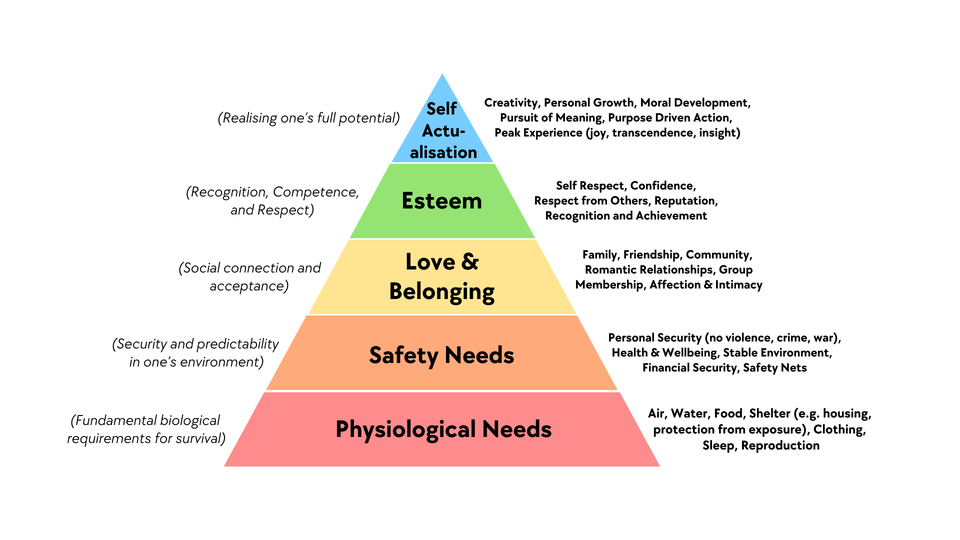
<p>I began approaching life through an <a href="/blog/catsitting/">inverse kinematic lens</a>—broadly setting goals weighted by Maslow’s hierarchy of needs, and reverse engineering my decisions based off a current best guess which also accounts for unknown stimuli.</p>

<h2 id="tolstoy-in-context">Tolstoy, in context</h2>
<h3 id="logical-nihilism">Logical nihilism</h3>
<p>It was under this philosophical context in which I read Tolstoy’s <em>Confession</em> for our Origins and Meaning course. He painted a logically nihilistic picture of the world and our human reactions to it, and I empathized with his struggle to rationalize meaning beyond our “temporary, random conglomeration of particles” (Tolstoy 41),</p>

<blockquote>
  <p>“You are a little lump of something randomly stuck together. The lump decomposes. The decomposition of this lump is known as your life.” (Tolstoy 42)</p>
</blockquote>

<h3 id="reactions-to-meaninglessness-a-state-of-flux">Reactions to meaninglessness: A state of flux</h3>
<p>Within a meaningless world, Tolstoy writes that people of his educated, material class broadly have four means of escaping their situation:</p>
<ol>
  <li>Ignorance</li>
  <li>Epicureanism</li>
  <li>Strength (suicide)</li>
  <li>Weakness (living in despair)</li>
</ol>

<p>And I thought back to my current state of flux; always oscillating between (2) gorging myself on food and alcohol and (4) despairing as I jump from one deadline to another. (Alongside the constant, unknowable threat of (1).)</p>

<h3 id="on-faith-as-seen-in-interstellar">On faith (As seen in Interstellar)</h3>
<p>I was excited to see Tolstoy call back to the concept of faith; in the same form as when I’d seen it last in <em>Interstellar</em>. And that this was the very concept which rejuvenated his will to live:</p>

<blockquote>
  <p>“Faith is the force of life… If (a man) fails to see and understand the illusory nature of the finite, then he believes in the finite. If man understands the illusory nature of the finite, then he must believe in the infinite. Without faith it is impossible to live.” (Tolstoy 61)</p>
</blockquote>

<p>When I told my friends the message I took away from <em>Interstellar</em> was “faith,” they frowned at me; saying that faith to them is necessarily entangled with institutions of religion that are antithetical to what <em>Interstellar</em> is about. But Tolstoy’s definition, of faith as a force of life, guiding one through life, of being the oars enabling us to keep rowing against questions we can’t yet answer—this was what I meant.</p>

<h3 id="institutional-qualms">Institutional qualms</h3>
<p>Moreover, Tolstoy took the same qualms as I had in response to religion: Why must believers of other creeds be necessarily living in a lie, such that they deserve to die? That he still chose faith in spite of this, and chose to denounce parts of the institutional machinery of religion while still remaining faithful—was inspiring.</p>

<h3 id="the-moral-stage">The moral stage</h3>

<p>Moreover, Tolstoy learned to bear the cognitive dissonances of the Bible’s mythical stories, of 500 year old men, alchemy, and reincarnation by extracting their moral wisdom: “Taking exception to the miracles and viewing them as fables that expressed an idea, these readings revealed to me the meaning of life.” (Tolstoy 83)</p>

<p>Instead he landed upon a set of virtues I’d forsaken in my flux between ego and hedonism:</p>
<ul>
  <li>“[W]e must renounce the sensual pleasures of life; we must labor, suffer, and be kind and humble.” (Tolstoy 78)</li>
</ul>

<p>Perhaps it is this context which would best set the stage for my final project for this course, ParableGPT.</p>

<h2 id="parablegpt-in-context">ParableGPT, in context</h2>
<p>Admittedly, ParableGPT was incepted before I’d read Tolstoy. The idea was simple: to train a locally-hosted large language model (LLM) to spit out parables in the style of various religions using retrieval-augmented generation (RAG).</p>

<p>Rather, the idea for ParableGPT came from wanting to poke fun at the untouchable sanctity of holy literature; a snapshot of my own spiritual views at the time, concerning the unceremonious nature of cognition and human language as sophisticated probability maximizing machines.</p>

<h3 id="the-large-language-model">The large language model</h3>
<p>Underlying ParableGPT is an LLM, a computational neural network, with ‘neurons’ (each storing a single number) arranged in layers, such that:</p>
<ul>
  <li><strong>Input layer:</strong> Sensory data</li>
  <li><strong>Intermediate layers:</strong> Feeds through one or more intermediary layers
    <ul>
      <li>The numeric value of any given neuron is some linear combination of the neuron values in the layer preceding it.</li>
    </ul>
  </li>
  <li><strong>Output layer:</strong> Is mapped to the final output of the network</li>
</ul>

<p>The most powerful, present-day LLMs tweak the neural network structure by optimizing it for the sequential nature of language through the transformer architecture. <a href="https://www.ibm.com/think/topics/transformer-model">This IBM article</a> explains those better than I can.</p>

<h3 id="as-an-analogue-for-the-human-brain">As an analogue for the human brain</h3>
<p>Neural networks are a particularly powerful tool because they mirror how our brain’s neurons are organized as well.</p>

<p>Our brains operate through a network of approximately 86 billion neurons. Each neuron in the net is connected to as many as several thousands of other neurons through junctions called synapses. By sending electrochemical signals to its connected neighbors, the interconnected web of neuronic signals eventually map certain combinations to the biological processes governing what we experience as thoughts, feelings, and actions.</p>

<p>To put it more concretely, the following analogues can be drawn between large language models and our human brain:</p>
<ul>
  <li>Neural net architecture - Our brain, pretrained through DNA instruction encoding generations of evolution</li>
  <li>Fine-tuning on new datasets - What we individuals learn through our experiences</li>
  <li>RAG - Asking someone a question in an open-note exam</li>
</ul>

<p>So in my artificial world, it was as if I had found a capable-enough brain, fine-tuned on listening to instructions, to generate parables while giving them a wide library of sacred scriptures to aid their writing with.</p>

<h2 id="implementation">Implementation</h2>
<p>There’s a lot of theory that I’m skipping over, because implementing a neural network is thankfully much simpler than designing one from scratch. For ParableGPT, I used Meta’s <code class="language-plaintext highlighter-rouge">Llama3.1-8B-Instruct</code> model, named aptly because it has 8 billion training weights across all its different layers, and is fine-tuned to listen to instructions.</p>

<p>A greater discussion of my implementation details can be found in <a href="https://github.com/hyuncat/parable-gpt/blob/main/usage.ipynb">this Jupyter notebook</a> which walks through the entire process.</p>

<h2 id="results">Results</h2>
<p>For a small, open-source model run entirely on my computer, ParableGPT performed much better than I expected. The following is an output asking it to generate a parable in a Taoist style about the concept of “The Way.”</p>

<p><img src="/assets/images/blog/2025-12-24-parablegpt/parable.png" alt="hi brian" width="700" /></p>

<h3 id="considerations">Considerations</h3>
<p>Admittedly, the responses maintained a distinctive “GPT” writing quality (many stories begin “once upon a time, in a small town nestled between two great mountains” or “rivers” or such.)</p>

<p>Still, the stories were cohesive (unlike my non-RAG’ed attempts) and the moral teachings remained apt.</p>

<p>I imagine if I had shelled out the money on GPT 5.2 API tokens, or had been more clear in my stylistic instructions, I would have gotten even higher quality responses.</p>

<h2 id="reflections">Reflections</h2>
<h3 id="morals-across-religions">Morals across religions</h3>
<p>Across the different parables generated, I was able to get a sense of the different values specific to each religion.</p>

<h4 id="christianity">Christianity</h4>
<ul>
  <li>Love God, your neighbor, and even your enemies</li>
  <li>Show mercy to the needy</li>
  <li>Give up worldly desires</li>
  <li>Repent for your sins</li>
  <li>Keep your vows</li>
  <li>Fear God</li>
</ul>

<h4 id="buddhism">Buddhism</h4>
<p>Avoid suffering by maintaining the following:</p>
<ul>
  <li>No killing</li>
  <li>No stealing</li>
  <li>No sexual misconduct</li>
  <li>No wrong speech</li>
  <li>No intoxicants
Moreover, desire is the root of suffering.</li>
</ul>

<p>And live life in accordance with the noble eightfold path</p>
<ul>
  <li>Right speech</li>
  <li>Right action</li>
  <li>Right livelihood</li>
</ul>

<p>With the goal of nirvana—liberation from suffering and the cycle of rebirth</p>

<h4 id="islam">Islam</h4>
<ul>
  <li>Uphold justice</li>
  <li>Strive for excellence</li>
  <li>Be humble</li>
  <li>Forgive others</li>
  <li>Give to the needy</li>
  <li>Respect parents and elders</li>
  <li>Fear God</li>
</ul>

<h4 id="taoism">Taoism</h4>
<ul>
  <li>“Tao” (harmony) - the balance between yin and yang, of accepting imperfections as enhancing the beauty of the whole</li>
  <li>Live simply</li>
  <li>Live modestly</li>
  <li>Wu Wei - Effortless action in harmony with the world</li>
</ul>

<p>And to strive to live in accordance to the three treasures:</p>
<ul>
  <li>Compassion</li>
  <li>Frugality</li>
  <li>Humility</li>
</ul>

<h3 id="common-themes">Common themes</h3>
<p>The common themes behind the moral teachings were</p>
<ul>
  <li>Respect God</li>
  <li>Forgive others</li>
  <li>Uphold justice</li>
  <li>Don’t strive for the material</li>
  <li>Strive for balance</li>
</ul>

<p>Taken at face value, these seem like decent-enough, prosocial ways to conduct your life.</p>

<p>This mirrors how Pascal Boyer in “Religion Explained,” explains that religions make moral rules more intelligible through stories and myths. And that while the concepts may differ between religious traditions, the questions they try to answer are broadly the same:</p>
<ol>
  <li>What happens after death?</li>
  <li>How should we cope with suffering?</li>
  <li>How should we live?</li>
</ol>

<p>These morals take the form of different characters across religions, but share the same <em>template</em>—a term Boyer uses to describe devices with empty fields for concept-dependent attributes allowing minds to reach similar representations of concepts (Boyer 45), including religious ideas.</p>

<p>Using this definition, ParableGPT and my interaction with this course has illuminated religion’s societal function as a template for meaning. In this sense, religion</p>
<ul>
  <li>Bridges the finite with the infinite - how to live our lives now that we are part of something greater</li>
  <li>Gives us values to deal with life’s suffering</li>
  <li>Gives us prosocial values which help us form communities</li>
</ul>

<h3 id="artificial-intelligence-and-free-will">Artificial intelligence and free will</h3>
<p>Earlier in the semester, we read Dan Dennet’s thought experiment in <em>Where am I</em>.</p>
<ul>
  <li>Dan, staring into his brain being kept alive in a vat, connected to his body via radio signals, questioning if he is his brain, or his body.
It was an unnerving read, exposing the inherent fragility in how our notion of consciousness breaks down; relying on memories, both physical and metaphysical, to be strung onto an easily toppled clothesline of narrative continuity.</li>
</ul>

<p>With the growing ubiquity of artificial intelligence, and the looming threat of human-level <a href="https://en.wikipedia.org/wiki/Artificial_general_intelligence">AGI</a>, the question of artificial consciousness grows ever near.</p>

<p>When cleverly integrated with a Turing machine, LLMs already “think” in the same way that human brains do. The newest AI models from OpenAI and Google DeepMind come equipped with reasoning facilities score gold medals in the International Mathematical Olympiad. When defined as the ability to reason and generate new content from the synthesis of disparate connections, LLMs have been ‘thinking’ for a while.</p>

<p>In particular, once large foundation models find suitable robotic homes to interact with and learn from their environment, human-specific cognition will be a hard line to draw. My answer at where the line falls draws back to Dan’s ideas: Consciousness relies on the gap between physical and metaphysical to be not only sufficiently closed, but adeptly interwoven.</p>

<p>It’s at that point, that I feel artificial intelligence will drop the final hammer in the discussion over free will, as a walking counterexample: A quasi-deterministic program, exhibiting similar displays of “free will,” but being completely designed by non-divine hands.</p>

<h2 id="closing-notes">Closing notes</h2>
<h3 id="a-dear-lunch">A dear lunch</h3>
<p>While working on this project, I in parallel had a fateful lunch with my dear mentor and NYU professor, Dennis Shasha last Monday. We talked about meaning in research, on helping people, his marital strategy of aikido, and his general philosophy of Spinozism and Stoicism.</p>

<h3 id="on-stoicism">On Stoicism</h3>
<p>The principles of Stoicism, I’d been following myself for a while. Dennis summed up what he likes about that philosophy in three points:</p>
<ul>
  <li>Don’t worry about what you can’t control</li>
  <li>Improve yourself every day</li>
  <li>Death is nothing to fear</li>
</ul>

<h3 id="spinozism">Spinozism</h3>
<p>Spinozism, I had never heard of. It was a framework which placed distrust in religious institutions, and drew a crucial equality: God and the universe are the same. He had embedded his views on Spinozism in a new puzzle book he was writing.</p>

<blockquote>
  <p>“My view is pretty much the same as the 17th century philosopher Spinoza’s: God and the universe are the same,” Ecco replied. “The universe is neither moral nor immoral. There is no deity guaranteeing that good things will happen to good people. To live together in a society we need laws and enforcement. A society can encourage the Golden Rule to bring harmony to situations beyond the reach of law enforcement, but that is a choice people must make.” - Dennis Shasha</p>
</blockquote>

<p>It was the connection I was looking for, neatly bridging my present physics-guided understanding of the universe with the framework of religious morality and meaning I’d learned in childhood.</p>

<h3 id="revisiting-religion-1">Revisiting religion</h3>
<p>Under this new framework, the stories I’d read growing up began making sense. God-fearing piety, when applied to Nature, becomes a general reverence for the world, its inhabitants, and supports the desire to understand more of its mysteries.</p>

<p>I revisited the fundamental questions of religion under Spinozism:</p>

<ol>
  <li>What happens after death?</li>
  <li>How should we cope with suffering?</li>
  <li>How should we live?</li>
</ol>

<p>Now, I could take my Catholic upbringing, or a lot more religions now for that matter, replace “God” with “Universe”, discard any romantic answers to the first question and feel justified in its answers to the other two.</p>

<p>Rather, my answer to the first question, and to Tolstoy’s existential impetus for faith, rests on my now-certain belief in a <a href="https://www.amazon.com/Death-Afterlife-Berkeley-Tanner-Lectures/dp/019046917X">Scheffer-like collective afterlife</a>—in which, being a part of the Universe is the greatest ‘collective’ available. That my actions will be forever memorialized through the ripples of their cause-effect chains, propagated by the ever-increasing arrows of time and entropy. And that my remains will fertilize the soil, feeding the blooms atop it.</p>

<h2 id="works-cited">Works cited</h2>

<p>Boyer, Pascal. <em>Religion Explained: The Evolutionary Origins of Religious Thought.</em> Basic Books, 2001.</p>

<p>Dennett, Daniel C. “Where Am I?” <em>Brainstorms: Philosophical Essays on Mind and Psychology</em>, MIT Press, 1978, pp. 310–323.</p>

<p>IBM. “What Is a Transformer Model?” <em>IBM Think</em>, www.ibm.com/think/topics/transformer-model. Accessed 24 Dec. 2025.</p>

<p>Scheffler, Samuel. <em>Death and the Afterlife</em>. Oxford UP, 2013.</p>

<p>Tolstoy, Leo. <em>A Confession</em>. Translated by David Patterson, W. W. Norton, 1983.</p>]]></content><author><name>Sarah Hong</name><email>ssh2198@columbia.edu</email></author><category term="philosophy" /><category term="religion" /><category term="meaning" /><summary type="html"><![CDATA[The repository for ParableGPT can be found here.]]></summary></entry><entry><title type="html">A meditation</title><link href="https://hyuncat.com/blog/meditation/" rel="alternate" type="text/html" title="A meditation" /><published>2025-12-09T00:00:00+00:00</published><updated>2025-12-09T00:00:00+00:00</updated><id>https://hyuncat.com/blog/meditation</id><content type="html" xml:base="https://hyuncat.com/blog/meditation/"><![CDATA[<h2 id="a-meditation">A meditation</h2>

<p>Dipping my toes into a cool pond<br />
       encircled by firs,<br />
       the murmurs of forest life,<br />
       and an array of stars clattering about</p>

<p>the chill shakes my spine awake<br />
as I ease my body into its cobalt still.</p>

<p>I close my eyes.</p>

<p>Inside the water,<br />
      thoughts rise and bubble,<br />
       washing over myself.<br />
       Sometimes their suds turn<br />
       into mermaid fins, and seashells.<br />
Outside the water,<br />
       more thoughts<br />
       racously bouncing<br />
       tracing along the rim of the pond<br />
       bristling against dim blades of grass.</p>

<p>Sighing, I lift myself up<br />
and sit atop the sill of the pond.<br />
The cold air breathes lukewarm onto my wet skin.</p>

<p>A cricket perches itself on my thigh<br />
an ugly thing, it ruins the mood.</p>]]></content><author><name>Sarah Hong</name><email>ssh2198@columbia.edu</email></author><category term="poem" /><summary type="html"><![CDATA[A meditation]]></summary></entry><entry><title type="html">Fall 2025</title><link href="https://hyuncat.com/blog/fall-2025/" rel="alternate" type="text/html" title="Fall 2025" /><published>2025-12-01T00:00:00+00:00</published><updated>2025-12-01T00:00:00+00:00</updated><id>https://hyuncat.com/blog/fall-2025</id><content type="html" xml:base="https://hyuncat.com/blog/fall-2025/"><![CDATA[<p>This fall semester slipped through my fingers…</p>

<p>As part of the Work Exemption Program, I’ve continued working in the Gang Lab in their pursuit to have self assembling DNA nano-materials uproot the semiconductor industry from the ground up. This semester, I took on a smaller project, to finish up my lab-idol’s “Binding Library” project. This, combined with a lighter courseload, was done in the intent of applying to PhD. programs in December.</p>

<p>The following series of blog posts aims to capture the totality of my semester: detailing the main story beats, and including my academic, professional, and philosophical takeaways from this hectic semester.</p>

<ul>
  <li><a href="/blog/binding-library">Explaining the Binding Library project</a></li>
  <li><a href="/blog/alcoholism2">Alcohol is my culture!</a></li>
  <li><a href="/blog/thoughts">Thoughts, and the lack thereof</a></li>
  <li><a href="/blog/makecu">The MakeCU retrospective</a></li>
  <li><a href="/blog/gap-year">On burnout</a></li>
</ul>

<p>I am once again grateful to the Work Exemption Program for giving me the space to fund my semester and reflect on my takeaways.</p>]]></content><author><name>Sarah Hong</name><email>ssh2198@columbia.edu</email></author><category term="ganglab" /><category term="research" /><category term="retrospective" /><category term="cs" /><summary type="html"><![CDATA[This fall semester slipped through my fingers…]]></summary></entry><entry><title type="html">On burnout</title><link href="https://hyuncat.com/blog/gap-year/" rel="alternate" type="text/html" title="On burnout" /><published>2025-11-25T00:00:00+00:00</published><updated>2025-11-25T00:00:00+00:00</updated><id>https://hyuncat.com/blog/gap-year</id><content type="html" xml:base="https://hyuncat.com/blog/gap-year/"><![CDATA[<h3 id="hesitancy">Hesitancy</h3>
<p>It was November 13th, and I was staring down the big, scary “December 1st” deadline on the MIT EECS program website. I’d just recovered from planning MakeCU, and I hadn’t asked a single one of my professors for a letter of recommendation.</p>

<p>Why was it so hard to send the email?</p>
<ul>
  <li>I kept telling myself I had to do more work on the research project before daring to ask them for a letter.</li>
  <li>But with leading MakeCU and the Robotics Club in general, on top of my normal schoolwork deadlines… I felt at a standstill with my responsibilities, and desperately wanted a break from life.</li>
</ul>

<h3 id="locking-in-with-dan">Locking in with Dan</h3>
<p>I text Dan McKeen, a recent doctoral defendee and resident super-senior of the Gang Lab, asking if he was still in the office. If I could do work with him. He said sure, and I paused my Balatro game, threw a jacket on top my PJs, and crawled over to the 3rd floor of Mudd.</p>

<p>I sat down next to his office cubicle, and Dan asks, double checking that I’ve “surely asked professors for letters of recommendation by now, right?” I buried my face into my hands and avoid eye contact. He tells me “Sarah. There’s two weeks left until your first deadline. Lock in.”</p>

<p>We spend the rest of the night sending out all three emails to my professors. I make accounts for the application portals at each of the schools I’m thinking of applying to, and start drafting outlines for my personal statement and research statement of intent. I left that 2 hour work session having made more progress on my PhD. applications than I had made in the entire semester preceding it.</p>

<p>I slept that night, feeling uneasy still.</p>

<h3 id="re-letter-of-recommendation">RE: Letter of recommendation</h3>
<p>I wake up the next morning to three emails.</p>
<ol>
  <li>Dr. Gang agrees, asking me to send a writeup detailing what I’ve done for the Gang Lab.</li>
  <li>Professor Tony Dear notes that it’s a little late, but that we could try to make it work.</li>
  <li>My NYU professor and super-mentor, Dennis Shasha, shoots me a brutally honest response.</li>
</ol>

<blockquote>
  <p>Dear Sarah,</p>

  <p>In principle, I’m happy to write a letter for you. However, I would have been <em>so</em> much happier if this project were done as we planned to have it done for this summer, because then my letter could attest to its usefulness for people and the paper we would have published.</p>

  <p>Also, to me,  you look to be a little burned out as a student. I would really want you to wait a year not being a student. There is life outside, even if you are in a lab helping with research.</p>

  <p>Nevertheless, if you feel strongly that you want to do this, then I will write a letter. What I need from you is a word document written in the third person (e.g. Sarah did X) with</p>

  <p>when Sarah started</p>

  <p>Sarah’s main accomplishments in our work together</p>

  <p>Warmly,<br />
Dennis</p>
</blockquote>

<p>After reading his email, in some way, I felt relieved. Because I knew I had been blowing off my research deadlines to Dennis for the entire summer and fall semester, be it through preparing for MakeCU or otherwise. It was his sentiment of disappointment which I was dreading; now that I’d heard it, my gut could stop catastrophizing over it.</p>

<p>I told him I was open to the idea of waiting a year, but that I would appreciate guidance on how to move forward—asking if we could talk more on this the next time we met. He warmly agreed, offering we meet at 4pm the same day.</p>

<p>I sent over screenshots of our emails to Dan, and asked him if he had time before the meeting to chat. He said sure.</p>

<h3 id="a-lunch-with-dan">A lunch with Dan</h3>
<p>Over a green chipotle chicken wrap, we talk in the cafe inside the Philosophy Building. Dan tells me that a gap year is not a bad idea, “smart even.” and explains that he’s never been convinced I actually wanted to go to grad school, given that I started preparing an application I should have started three months ago, three days ago.</p>

<p>I tell him that research is the end goal for me. That I love the creative process of long-form problem solving, and how it ultimately ties into my goals of doing industry ML / robotics research at a company. And that research and robotics (and math, in hindsight) have been the only things during my time at Columbia which have felt “real.”</p>

<p>He says fine, but that my GPA’s on the edge for the schools I’m wanting to apply to, and that I simply don’t have enough time to put together a compelling application this year. And that my letter writers don’t either. I leave the conversation with my head hung low, silent and resigned.</p>

<h3 id="denniss-advice">Dennis’s advice</h3>
<p>4pm arrives sooner than I’m able to catch my breath. I log onto Zoom to see Dennis’s familiar, smiling face. “Sarah, sweetie. How are you?”</p>

<p>I explain to him my situation and motivation for applying to grad school—the same reasons I told Dan over lunch.</p>

<p>Dennis tells me that the first time he met me, he saw I was full of vigor and enthusiasm. In contrast, he says that these days, I just look tired.</p>

<p>He explains that he felt the same in his senior year of undergrad. He was sick of school and took three years off to work at IBM, with the intention of never coming back. However, during his time there, he developed a clearer understanding of the world, and grew a burning hunger to go back to school.</p>

<p>I ask him, “what’s the harm in applying this cycle?”</p>

<p>He tells me that my application will be much stronger next year—with our project wrapped up, he will be able to write a much more compelling letter of recommendation. Moreover, he explains that admissions committees will be more wary to accept someone who has already applied and been rejected.</p>

<p>With that, I resigned myself to his wisdom. I tell him that I’ll take his advice. Slapping my face into shape, I say: “Time to find a job.”</p>]]></content><author><name>Sarah Hong</name><email>ssh2198@columbia.edu</email></author><category term="research" /><category term="personal" /><summary type="html"><![CDATA[Hesitancy It was November 13th, and I was staring down the big, scary “December 1st” deadline on the MIT EECS program website. I’d just recovered from planning MakeCU, and I hadn’t asked a single one of my professors for a letter of recommendation.]]></summary></entry><entry><title type="html">The MakeCU retrospective</title><link href="https://hyuncat.com/blog/makecu/" rel="alternate" type="text/html" title="The MakeCU retrospective" /><published>2025-11-12T00:00:00+00:00</published><updated>2025-11-12T00:00:00+00:00</updated><id>https://hyuncat.com/blog/makecu</id><content type="html" xml:base="https://hyuncat.com/blog/makecu/"><![CDATA[<h2 id="seedlings-of-makecu">Seedlings of MakeCU</h2>
<p>MakeCU planning started in June, shortly after I got back from ICRA.</p>

<p>It was me and a squad of ~8 other people meeting over Zoom every week to talk about what work we’ve done, or have to get done, and by when.</p>

<h3 id="preliminary-lessons-on-leadership">Preliminary lessons on leadership</h3>
<p>A lesson I learned early on was the art of starting and ending meetings: In research and violin, I’m the one answering to my PI / instructor. But here, people answered to me to lead the meetings. After too many meetings with awkward “okay… see you next week?” I realized the trick was to end with a statement—intonation down.</p>

<p>Through running these meetings, I ran into some more, damning problems:</p>
<ul>
  <li>Work not assigned never got done.
    <ul>
      <li>As a corollary, people rarely volunteer themselves.</li>
    </ul>
  </li>
  <li>Zoom meetings can turn impersonal quickly - cameras, mics, and agency off.</li>
  <li>People don’t make decisions for themselves and only wait for me to “assign tasks” to them</li>
</ul>

<p>I wanted to gravitate away from me lecturing people the entire time, and steer the conversation toward being more productive and collaborative, and friendly. In an ideal world, we would all be friends working together on something we cared about.</p>

<h2 id="hackcon">HackCon</h2>
<h3 id="the-hackathon-ceiling">The hackathon ceiling</h3>
<p>As an MLH-affiliated event, I ended up finding my way into their annual hackathon organizer conference in Copake, New York. Though a little corny, it was quite illuminating to see how high the ceiling for hackathons could be. At other schools…</p>
<ul>
  <li>Teams are getting 150k+ in sponsorships</li>
  <li>They’re sifting through 10k applicants</li>
  <li>One team crafted personality quizzes out of their application forms and hid CTFs in their websites (Hack the North). They also had an “engineering subteam” of 15 people, all dedicated to data analytics, website development, etc.</li>
</ul>

<h3 id="hackathons-and-the-mlh-machine">Hackathons, and the MLH machine</h3>
<p>I also grew more invested in the hackathon as a concept—of being the glue between an engineering undergraduate degree and an engineering job in industry.</p>

<p>MLH’s role in the whole operation was fascinating in its own right. They essentially act as an umbrella organization connecting sponsors to hackathons and skimming part of the fat off the top.</p>
<ul>
  <li>They were an organization of community builders, each invested in organizing hackathons.</li>
  <li>It was a space which was “love-and-kindness”-pilled in a way that I never expected myself to inhabit at the same time.</li>
</ul>

<h2 id="locking-back-in">Locking back in</h2>
<p>After that weekend, I came back and shared the spoils of knowledge with everyone else on the MakeCU team.</p>

<h3 id="functionalizing-people-through-responsibility">Functionalizing people through responsibility</h3>
<p>I also returned with a renewed mind on delegation: if I reconnect people’s roles to a certain “responsibility,” (eg, being “responsible” for the website displaying accurate information) and asking them to make decisions to get them toward that goal in a more self-guided manner.</p>

<h3 id="components-of-the-team">Components of the team</h3>
<p>Distilling everything I learned about organizing a successful hackathon is way beyond the scope and time constraints of this blog post. But the essential components were as follows</p>
<ul>
  <li>Money
    <ul>
      <li>Sponsorship</li>
      <li>Finance</li>
    </ul>
  </li>
  <li>Events
    <ul>
      <li>Workshops</li>
      <li>Food</li>
      <li>Prizes</li>
    </ul>
  </li>
  <li>Logistics
    <ul>
      <li>Venue</li>
      <li>Safety</li>
      <li>Orders</li>
    </ul>
  </li>
  <li>Engineering
    <ul>
      <li>Website</li>
      <li>Hardware</li>
    </ul>
  </li>
  <li>Marketing
    <ul>
      <li>Social Media</li>
      <li>Merch</li>
    </ul>
  </li>
</ul>

<h3 id="memorable-moments">Memorable moments</h3>
<p>For crafting a comprehensive <strong>hardware list</strong>, I latched onto some friends who I knew were more hardware-literate than I was. James, Isaac, and I met up over a series of lunches to plot out the list of components to order, and how we should effectively distribute it.</p>

<p><strong>Sponsor acquisition</strong> was fun—emailing and talking to sponsors taught me how to distill the hackathon deal down into what we want (money to organize the event) vs. what they get (advertising, recruitment, philanthropy), and how to convey that information in a compelling way.</p>

<p>Also noteworthy was the frustrating amount we brushed up against <strong>Columbia’s administrative machinery</strong>. Every purchase needed a meeting to have it placed. Merch could only be ordered through specific vendors out of “fair labor concerns.” Prizes could <em>only</em> be ordered from the Columbia University Bookstore—to ward off money laundering, nominally.</p>

<h3 id="sprint-to-the-finish">Sprint to the finish</h3>
<p>The week leading up to it was a sprint to the end. T-shirts ended up arriving a couple days before Nov 8th, and I raced to design certificates, nametags, and overseeing that all the merch got printed as they should. Joseph (the goat) handled the hacker communication.</p>

<p>The night before, Joseph, Isaac, Matt, and I stayed from 6:00pm to 2:00am getting every small task ready for the hackathon: Opening / closing ceremony slides, judging forms, day-of emails to hackers, check-in forms, cutting nametags.</p>

<h2 id="the-day-of">The Day Of</h2>

<h3 id="a-24hr-exam-non-stop-focus">A 24hr exam: Non-stop focus</h3>
<p>If the week before was a sprint, the Day Of felt like a marathon of intense focus and multitasking. My job was to:</p>
<ul>
  <li>Greet and entertain sponsors
    <ul>
      <li>Write thank-you cards (which was done hastily, during the morning-of Nov 9th, in the CS lounge)</li>
    </ul>
  </li>
  <li>Lead the opening and closing ceremonies
    <ul>
      <li>Update the closing ceremony to reflect the winners</li>
    </ul>
  </li>
  <li>Corral both hackers and organizers to do things
    <ul>
      <li>Make sure food arrived and was served when it was supposed to</li>
      <li>Setup and teardown</li>
      <li>(At some point, I had a 7ft guy from the business school help yell at people to go places 😂)</li>
    </ul>
  </li>
</ul>

<p>Joseph was genuinely my other half throughout the event. Hell, it was probably a 80:20 him:me cognitive load split on the day-of. (Facilitated by him just being insane.)</p>

<h3 id="an-air-of-ambition-hope-and-redbull">An air of ambition, hope, and Redbull</h3>
<p>The final project expo was really heartwarming. The calibre of projects this year was much greater than of last year. The unofficial theme was “trash,” and we saw five different variants of “smart trash can that sorts waste / finds waste disposal.”</p>

<p>The closing ceremony was filled with dozing heads, empty Redbull cans, and latent anticipation. The fact that MakeCU could convince participants to pull an all-nighter to finish their project filled me with a strange but proud feeling.</p>

<p>We announced the winners: a team named Ding Dong, who had built a smart doorbell which would unlock the door from the outside if your face was a verified user on the guest registry.</p>

<p>At the end, Celeste brought in flowers for me and Joseph.</p>

<p><img src="/assets/images/blog/2025-11-12-makecu/meandjo.jpg" alt="Tightrope walker" width="600" /></p>

<h2 id="afterword">Afterword</h2>
<h3 id="the-victory-dinner">The victory dinner</h3>
<p>It was only after the closing ceremony, after saying goodbye to the final sponsor, that I felt like I could finally relax. The team stayed back to clean-up the hardware, and after people slowly dropped out, the remaining four stragglers all went for dinner at Sala Thai.</p>

<p>Afterwards, I went home and slept.</p>

<h3 id="pride-and-sweat-laden-takeaways">Pride and sweat-laden takeaways</h3>
<p>I was non-verbal for half of the next day out of shell-shock. Honestly, I still haven’t mentally recovered. But, I’ve started feeling genuinely proud of myself.</p>

<p>Organizing MakeCU will forever stay with me for the lessons it taught me on leadership, organizations, and the ways in which working with other people can break down. The combined effort of us 10 led to an event which touched 100+ attendees and left a rippling impact on the Columbia community. It was challenging, grueling, but irrevocably rewarding.</p>

<h3 id="links">Links</h3>

<p>The final list of projects can be found <a href="https://makecu25.devpost.com/project-gallery">here</a>.</p>

<p>Columbia Engineering also wrote an article on us, called <a href="https://www.engineering.columbia.edu/about/news/24-hour-sprint-prototype-pitch">“The 24-Hour Sprint from Prototype to Pitch”</a>.</p>]]></content><author><name>Sarah Hong</name><email>ssh2198@columbia.edu</email></author><category term="ganglab" /><category term="research" /><category term="retrospective" /><category term="cs" /><summary type="html"><![CDATA[Seedlings of MakeCU MakeCU planning started in June, shortly after I got back from ICRA.]]></summary></entry><entry><title type="html">Thoughts, and the lack thereof</title><link href="https://hyuncat.com/blog/thoughts/" rel="alternate" type="text/html" title="Thoughts, and the lack thereof" /><published>2025-11-02T00:00:00+00:00</published><updated>2025-11-02T00:00:00+00:00</updated><id>https://hyuncat.com/blog/thoughts</id><content type="html" xml:base="https://hyuncat.com/blog/thoughts/"><![CDATA[<h2 id="the-problem-of-fragmentation">The problem of fragmentation</h2>
<h3 id="premise-chronically-overworked-and-sick-of-it">Premise: Chronically overworked, and sick of it!</h3>
<p>After overworking myself sophomore and junior year, this semester I tried finally listening to my friends’ advice and cut down on my time commitments. Taking easier classes and cutting down on projects, my responsibilities for the semester became:</p>

<ul>
  <li>Columbia Robotics Club
    <ul>
      <li>The club</li>
      <li>MakeCU</li>
      <li>CCBR project</li>
    </ul>
  </li>
  <li>Research
    <ul>
      <li>Gang Lab - Binding library</li>
      <li>Dennis - TuneBuddy</li>
      <li>PhD. applications</li>
    </ul>
  </li>
  <li>Violin
    <ul>
      <li>Columbia University Orchestra</li>
      <li>Columbia Music Performance Program</li>
      <li>Barrio Tango Orchestra</li>
    </ul>
  </li>
  <li>Coursework
    <ul>
      <li>(nothing hard)</li>
    </ul>
  </li>
</ul>

<h3 id="the-continuation-of-my-self-inflicted-problems">The continuation of my self-inflicted problems</h3>
<p>…which didn’t end up being a lighter workload at all.</p>

<p>The problem was x-fold:</p>

<ol>
  <li>Mode-switching between research projects is hard enough—to remember everything in a codebase takes at least 30m of warm-up (maybe 15m if well documented)</li>
  <li>Whenever I have a violin lesson, or a chamber coaching, or an orchestra rehearsal, it always derails the entire day—I end up getting the repertoire stuck in my head, my thoughts filled with thinking about what I did right and wrong and how I can improve</li>
  <li>Coursework is a constant</li>
  <li>Leading the robotics club means I have to always be on call: to members on my team, sponsors, Columbia administration, …
    <ol>
      <li>MakeCU requires constant attention, and is time-sensitive</li>
      <li>I have to acquire funding for ccbr, lead meetings, and coordinate meetings with Caltech and Rutgers</li>
    </ol>
  </li>
  <li>Decision-making is a highly self-guided process for both research and robotics… I have decision fatigue.</li>
</ol>

<p>Fragmented across so many responsibilities, I feel really overwhelmed.</p>

<h3 id="byung-chul-hans-serenity-of-an-animal">Byung-Chul Han’s “serenity of an animal”</h3>
<p>I think back to a book I read last semester, called “The Burnout Society” by Byung-Chul Han. There is a line where he describes the modern problem:</p>

<ul>
  <li>What used to be “you should” is now “you can”. We become “entrepreneurs of ourselves”, overworking ourselves into self-enforced subjugation</li>
  <li>“In this society of compulsion, everyone carries a work camp inside… One exploits onself.” (p. 19)</li>
  <li>Yet, we are “equipped with an ego just short of bursting…” if we didn’t, “one would at least have the serenity of an animal.” (p. 18)</li>
</ul>

<p>This neurotic desire to achieve, and the idea that the modern human is so overworked and stripped of thought that he becomes effectively a mechanistic animal without the serenity of one—has stuck with me.</p>

<h3 id="desire-for-escapism-and-repetition">Desire for escapism and repetition</h3>
<p>In my music humanities course, we were learning about modern music—and I thought back to Philip Glass and his repetitive, hypertonal works. In that vein, I made a playlist called <a href="https://open.spotify.com/playlist/4qJQO0BpXewYwZUXodFcau?si=162c320d65044aa0">“hold me”</a>, trying to comfort myself with his music.</p>

<p>I just wanted someone to tell me what to do, to be held by my mom again, and have her soothe my worries with the cheatcodes to figuring out my life.</p>

<h2 id="the-solution">The solution…</h2>
<h3 id="escapism-and-distraction-dopamine-farming">Escapism and distraction: Dopamine farming</h3>
<p>Last week, I was sick with the flu. To pass the time, I decided on a whim to download Balatro. I ended up playing Balatro for 12 hours straight that day.</p>

<p>It was refreshing, challenging, and addicting. Learning about the different joker abilities, various poker hand odds, money management—it was a whole new world to explore. Most importantly, it was wholly detached from the existential threat of phd applications, research deadlines, and MakeCU. In this world, lie round after round of bite-sized problems i could realistically solve—and the delivery of dopamine when I answered correctly.</p>

<p>But it was a fake world, with fake problems. I was distracting myself from my deadlines, from reaching out to MakeCU sponsors, from finishing my research projects, hell, from even asking my professors for letters of recommendation. Moreover, it was eating into my already overly limited time.</p>

<h3 id="the-real-solution-a-time-sensitive-approach">The real solution: A time-sensitive approach</h3>
<p>Of course, the real solution is to face my problems head on. And to this end, I have two time horizons to segment the solution methodologies by:</p>

<p>(1) In the short term, I should…</p>

<ul>
  <li>Improve my time management skills
    <ul>
      <li>block out time</li>
      <li>set realistic time estimates and mini-deadlines to incentivize progress</li>
    </ul>
  </li>
  <li>and construct an environment which is conducive to working.
    <ul>
      <li>set routines to initiate deep work and reducing the activation energy to starting</li>
      <li>remove deleterious apps (like Instagram…)</li>
      <li>ask friends to hold me accountable to the mini-deadlines I set</li>
    </ul>
  </li>
</ul>

<p>(2) In the long term, the solution is simple.</p>

<ul>
  <li>Limit the amount of projects I take on at once,</li>
  <li>and set realistic weekly time commitment estimates (including commitments to personal + social time) and stick to them.</li>
</ul>

<h3 id="implementation-notes">Implementation notes</h3>
<p>Unfortunately, these solutions are much easier said than done. (for instance, shortly after recovering from the flu, I distracted myself further by going on a trip to Boston for a weekend.)</p>

<p>I want to get better at keeping the promises I make to myself and others… which means fulfilling my responsibilities to my research PI’s, to my orchestra members, to my friends, and to my family for paying my college tuition. So hopefully I figure this time management thing out pretty soon.</p>]]></content><author><name>Sarah Hong</name><email>ssh2198@columbia.edu</email></author><category term="ganglab" /><category term="research" /><category term="retrospective" /><category term="cs" /><summary type="html"><![CDATA[The problem of fragmentation Premise: Chronically overworked, and sick of it! After overworking myself sophomore and junior year, this semester I tried finally listening to my friends’ advice and cut down on my time commitments. Taking easier classes and cutting down on projects, my responsibilities for the semester became:]]></summary></entry><entry><title type="html">Alcohol is my culture!</title><link href="https://hyuncat.com/blog/alcoholism2/" rel="alternate" type="text/html" title="Alcohol is my culture!" /><published>2025-10-28T00:00:00+00:00</published><updated>2025-10-28T00:00:00+00:00</updated><id>https://hyuncat.com/blog/alcoholism2</id><content type="html" xml:base="https://hyuncat.com/blog/alcoholism2/"><![CDATA[<h2 id="alcohol-is-my-culture">Alcohol is my culture!</h2>
<p>Over the summer, I spent time learning more about food and alcohol as part of my “learning more about the world” era. This semester, coursework and deadlines be damned, I kept treading along my quest to eat and drink well.</p>

<p>There was no concerted plan—just a guiding feeling that I wanted to keep trying new restaurants and bars. In the end, I ended up trying ~30 new places this semester.</p>

<p>Standouts include…</p>

<ul>
  <li>The fluffiest, chewiest lox bagel I’ve ever had (@Apollo Bagels),</li>
  <li>heartwarming udon noodles from Raku,</li>
  <li>a delightful corn pastry from Lysee,</li>
  <li>and a scarily accurate Japanese cold noodle cocktail from Double Chicken Please</li>
</ul>

<p>Underlying all this exploration, I also carved out time for a weekly pilgrimage to Cho Dang Gol. 😉</p>

<h3 id="random-access-memories-meals">Random access memories (meals)</h3>
<p>In the end, the common denominator I could all these places is ME: an upstart Korean American college student in her early 20’s, trying new restaurants based on her friends’ recommendations. As any recently converted foodie, I want to express some kind of individuality / good taste with my restaurant opinions.</p>

<p>So, how do the restaurants I visited + enjoyed really reflect back on who I am?</p>

<p>I think it has to do with whatever I have in common with the friend who recommended the place to me. Each recommendation itself comes from a story—Double Chicken Please came from the resident Gang Lab alcoholic, who broke up with an ex-girlfriend in college because she drank too much. Raku, from a summertime friend I’d gone clubbing with. Lysee, from a mentally unstable but brilliant robotics friend.</p>

<p>My best guess on who I am based on the food I like, is that I…</p>
<ul>
  <li>Value “humor” - innovation and creativity in flavor combinations</li>
  <li>Find comfort in warm Korean flavors</li>
  <li>Appreciate drier, grain-forward pastries over puddings
Which makes sense given that I grew up eating my immigrant mom’s cooking.</li>
</ul>

<p>But also, when I think about how I ate the same pork grain bowl from Ban Ban Shop for 4 months straight, I wonder where my particular balance of exploration vs. exploitation lies.</p>

<h3 id="exploration-vs-exploitation-dcp-vs-cdg">Exploration vs. exploitation: DCP vs CDG</h3>
<p>Over the summer, I had a conversation with a distant toxic acquaintance, who had revived a two-year-long silence to shit on a gastronomy-forward recipe I’d shared for being a sanitized and overly scientific way of approaching food. He argued that the goal of food and cooking should be to provide comfort, and that “Western cooking” lacks that.</p>

<p>Similarly, I think this argument touches on a similar point—how much should food and drink ‘explore’ and push the boundaries of flavor and texture beyond the scientific, as opposed to ‘exploiting’ and elevating existing ingredient combinations to perfection?</p>

<p>This dichotomy mirrors the difference between Cho Dang Gol vs. Double Chicken Please:</p>

<p>Double Chicken Please crafts drinks effusing the characteristic flavors of savory, solid foods (eg, “cold pizza,” “japanese cold noodles,” “key lime pie”) into still-tasty cocktails.</p>

<p><img src="/assets/images/blog/2025-10-28-alcoholism2/dcp.png" alt="Tightrope walker" width="400" /></p>

<p>Cho Dang Gol’s tofu stews are hearty, classic, immensely flavorful, and insanely comforting: they feel like a warm hug.</p>

<p><img src="/assets/images/blog/2025-10-28-alcoholism2/cdg.png" alt="Tightrope walker" width="400" /></p>

<p>In my opinion, both are good!</p>

<h3 id="pepero-day">Pepero Day</h3>
<p>I was walking back from orchestra rehearsal, feeling sentimental over distant-grown relationships. I realized it was 11/11 (Pepero Day!), and felt like re-investing in the people still in my life by buying all the Pepero I could find from Hmart.</p>

<p>I got three of my friends together to rank the flavors.</p>

<p><img src="/assets/images/blog/2025-10-28-alcoholism2/pepero.png" alt="Tightrope walker" width="700" /></p>

<p>In our rankings, our personalities shone through.</p>
<ul>
  <li>My nostalgia for strawberry pepero and love of the game</li>
  <li>Raghav’s commitment to science, overly precise numbers, and tinge of contrarianism</li>
  <li>Dan’s pretentious unpretentiousness and love for the exuberant</li>
  <li>Isaac’s straightforward unpretentiousness and honesty</li>
</ul>

<p><img src="/assets/images/blog/2025-10-28-alcoholism2/img8.png" alt="Tightrope walker" width="700" /></p>

<p>In lieu of a more granular flavor analysis, we even came up with some superlatives for them.</p>

<p><img src="/assets/images/blog/2025-10-28-alcoholism2/pepero_superlative.png" alt="Tightrope walker" width="500" /></p>

<p>It was a memorable night.</p>

<h2 id="takeaways">Takeaways</h2>
<p>What have I learned from all my indulgence?</p>

<p>Food is a vehicle of culture</p>
<ul>
  <li>Though I’ve historically preferred drier foods, being friends with a guy from Southern China has helped me learn to appreciate oily food—rich and flavorful foods</li>
</ul>

<p>Food is a science and an art</p>
<ul>
  <li>Being friends with a pretentiously unpretentious alcoholic has wisened me to the world of cocktail gastronomy - the art of recreating the essence of other flavor combinations within the morphology of an alcoholic drink</li>
</ul>

<h3 id="a-change-in-perspective">A change in perspective</h3>
<p>Funnily enough, I used to view food as a purely frivolous endeavor which only obstructed me on my health journey.</p>

<p>Over the past year, I’ve redefined my relationship with food as being a vehicle for social connection through a representation of culture, while satisfying the human need for sustenance.</p>

<p>In the same way we put in effort for relationships, I want to gain a baseline working understanding of all the components of life, including food and drink.</p>
<ul>
  <li>I predict the way to escalate my current engagement with food is to use what I’ve “consumed” to try and “create” (eg, through cooking).</li>
</ul>

<h3 id="drinking-and-living">Drinking and living?</h3>
<p>Earlier in the summer, while I was in my “wanting to flow out my life through axioms” phase: I asked my dad for feedback on my “live truthfully” axiom, asking if he had any of his on. He shared that his would be “정신 차리고 살자.”</p>

<p>I asked him how drinking alcohol fits into that axiom, to which he replied:</p>

<p>“Alcohol cools down my brain that is always occupied by too many things. So, it helps sometimes.”</p>]]></content><author><name>Sarah Hong</name><email>ssh2198@columbia.edu</email></author><category term="food" /><category term="philosophy" /><category term="indulgence" /><summary type="html"><![CDATA[Alcohol is my culture! Over the summer, I spent time learning more about food and alcohol as part of my “learning more about the world” era. This semester, coursework and deadlines be damned, I kept treading along my quest to eat and drink well.]]></summary></entry><entry><title type="html">Explaining the Binding Library project</title><link href="https://hyuncat.com/blog/binding-library/" rel="alternate" type="text/html" title="Explaining the Binding Library project" /><published>2025-10-20T00:00:00+00:00</published><updated>2025-10-20T00:00:00+00:00</updated><id>https://hyuncat.com/blog/binding-library</id><content type="html" xml:base="https://hyuncat.com/blog/binding-library/"><![CDATA[<p>This semester, I was tasked with finishing up the binding library project for Dan Redeker, and packaging it into a user-friendly interface. This blog post aims to explain what exactly this project is, in the hopes of also conveying why I find it cool.</p>

<h2 id="the-setting-dna-origami">The setting: DNA origami</h2>
<p>Some necessary prerequisite information about the Gang Lab: We are a material science research group, focused on a technique called “DNA origami.” The name comes from how we fold DNA into different shapes to form the basis of our nanomaterials.</p>

<h3 id="the-dna-origami-voxel">The DNA origami voxel</h3>
<p>Our lab works a lot with octahedral and tetrahedral dna origami wireframes, which we can “load” with arbitrary nanoparticles like gold.</p>

<p><img src="/assets/images/blog/2025-10-20-binding-library/img1.jpg" alt="Tightrope walker" width="800" /></p>

<p><img src="/assets/images/blog/2025-10-20-binding-library/img4.jpg" alt="Tightrope walker" width="200" /></p>

<h3 id="self-assembles-into-a-lattice">Self assembles into a lattice</h3>
<p>Dr. Gang’s work was influential in setting the foundations for the technique of using nanoparticle-loaded DNA origami as building blocks to create larger, tiling lattice structures.</p>

<p><img src="/assets/images/blog/2025-10-20-binding-library/img3.jpg" alt="Tightrope walker" width="800" /></p>

<h3 id="with-more-dna">With more DNA!</h3>
<p>Notably, this self assembly is enabled through the use of single stranded DNA sticking out at the vertices of the octahedra. These are used to connect different building blocks together, and only at certain sides, such that the desired nanoparticle structure is achieved through self assembly.</p>

<p><img src="/assets/images/blog/2025-10-20-binding-library/img2.jpg" alt="Tightrope walker" width="800" /></p>

<p>These single stranded sequences, also called “sticky ends” or “bonds”, are often abstracted away with using a single color to represent strands of differing base pair content—strands which in theory should not bind together.</p>

<h2 id="the-problem">The problem</h2>
<h3 id="structural-binding-errors">Structural binding errors</h3>
<p>However, if too many of the base pairs overlap, there’s a chance that a voxel can bind in the wrong orientation, leading to the propagation of structural binding errors.</p>

<p><img src="/assets/images/blog/2025-10-20-binding-library/img5.jpg" alt="Tightrope walker" width="900" /></p>

<h3 id="the-problem-statement">The problem statement</h3>
<p>Dan Redeker’s Binding Library project aims to address this problem of cross-contamination: given a DNA sequence length of N base pairs, what is the maximum ‘library’ of different sequences we can draw colors from, such that no two sequences will bind to any other sequence in the library other than to its rightful complement?</p>

<h2 id="dans-solution">Dan’s solution</h2>
<p>The solution was surprisingly elegant.</p>

<h3 id="define-orthogonal">Define orthogonal</h3>
<p>First, a definition: Two sequences are <strong>“orthogonal”</strong> to each other if they contain no matching subsequence of over 4 base pairs.</p>

<h3 id="the-method">The method</h3>
<ol>
  <li>Compute all possible DNA sequences of length 8</li>
  <li>e sort it two sets: A (color) and A’ (complementary) sequence spaces</li>
  <li>Compute all pairwise orthogonality between $A \times A$ and $A \times A’$ and store the two in a matrix.
    <ol>
      <li>This becomes a ‘graph’, where the values are booleans (1, 0) representing whether two sequences are orthogonal (1) or not (0).</li>
    </ol>
  </li>
  <li>Compute a third matrix containing the OR of the AA and AA’ matrices.
    <ol>
      <li>This accounts for the fact that a sequence C which is orthogonal to A will correspond to a sequence C’ which is orthogonal to A’.</li>
    </ol>
  </li>
  <li>Now apply a minimally connected graph algorithm.</li>
</ol>

<h4 id="rk-graph-theory-definitions">Rk: Graph theory definitions</h4>
<p>The following images are from Dan’s beautiful presentation on the project. Notes:</p>
<ul>
  <li>In this case, each “node” in the graph is a DNA sequence.</li>
  <li>Moreover, two nodes have an “edge” between them if they are orthogonal.</li>
</ul>

<p><img src="/assets/images/blog/2025-10-20-binding-library/img9.png" alt="Tightrope walker" width="800" /></p>

<h3 id="the-minimally-connected-graph-algorithm">The minimally connected graph algorithm</h3>

<p>Finally, the graph algorithm goes as follows:</p>

<p>While there exist nodes (vertices) in the graph…</p>
<ul>
  <li>Find the node with the lowest degree</li>
  <li>Remove that node from the graph and place it into our library.</li>
  <li>Remove the neighbors which used to be connected to that node from the graph as well.</li>
  <li>Repeat until there are no nodes left.</li>
</ul>

<p><img src="/assets/images/blog/2025-10-20-binding-library/img10.png" alt="Tightrope walker" width="800" /></p>

<p>The result is a library of “different-enough” DNA sequences (bonds) which we can use to connect our DNA origami lattices together.</p>

<p>Cool stuff!</p>]]></content><author><name>Sarah Hong</name><email>ssh2198@columbia.edu</email></author><category term="ganglab" /><category term="research" /><category term="cs" /><category term="graph-theory" /><summary type="html"><![CDATA[This semester, I was tasked with finishing up the binding library project for Dan Redeker, and packaging it into a user-friendly interface. This blog post aims to explain what exactly this project is, in the hopes of also conveying why I find it cool.]]></summary></entry><entry><title type="html">Jellyfish</title><link href="https://hyuncat.com/blog/jellyfish/" rel="alternate" type="text/html" title="Jellyfish" /><published>2025-08-29T00:00:00+00:00</published><updated>2025-08-29T00:00:00+00:00</updated><id>https://hyuncat.com/blog/jellyfish</id><content type="html" xml:base="https://hyuncat.com/blog/jellyfish/"><![CDATA[<h2 id="jellyfish">Jellyfish</h2>

<p>Crystal blue, beautiful entrails<br />
tangling themselves into the<br />
fibers of my muscles<br />
a bloom of jellyfish swimming through my over-trodden veins.<br />
It’s a cool sensation—their syrupy liqueur<br />
shooting through the toothpicks in my spine.</p>

<p>I don’t get it.</p>

<p>I’ve been skewered,<br />
and sprawled out like a taxidermied pig,<br />
pins stuck through every<br />
centimeter of jelly. Dissection?<br />
Or a minstrel show?</p>

<p>Wandering eyes come and go<br />
gawking at me. Pity, disgust,<br />
heat-seeking needles prodding at my insides<br />
trying to straighten out something<br />
that I didn’t want straightening in the first place.</p>]]></content><author><name>Sarah Hong</name><email>ssh2198@columbia.edu</email></author><category term="poem" /><summary type="html"><![CDATA[Jellyfish]]></summary></entry></feed>